
Start a Utah Property Records Search
Start with the county where the land actually sits. Utah has no single statewide recorder for everyday real-estate deeds. Each county keeps its own. With an address in hand, the county assessor can return a parcel number and the owner shown on the current roll. An old or partial address still works if you search by owner name or subdivision instead. Write down the parcel number and the full legal description before you jump between systems.
The next office depends on the question. A deed records the transfer. An assessor card shows today's roll fields. A treasurer account lists tax charges and payments. A GIS map adds geographic context. None of them alone proves ownership, value, and boundary all at once. Salt Lake County is a useful example, yet its search formats and portal features do not carry over to every Utah county.
- Identify the county from the situs address, then search its assessor or parcel portal.
- Save the APN, owner name as printed, mailing address, and legal description.
- Use the county recorder index to locate the latest deed or other instrument.
- Check the treasurer for tax charges and the county GIS for map context.
- Ask the custodian for a certified copy or an older record that is not online.
If an online result looks odd, compare dates and identifiers rather than picking one record as final. A new deed can be newer than the annual assessor roll. A map layer may lag the deed image too.
Who Keeps Utah Property Records
Parcel-level records live in local offices. The county recorder files deeds, liens, mining documents, and subdivision plats. The assessor keeps the parcel roll and valuation fields. Bills, payments, and delinquency steps belong to the treasurer or auditor. Cities contribute permits and zoning files for land inside their boundaries. The state sets standards and offers search tools. But it never merges ordinary deeds into one statewide owner database.
Utah Property Tax Division
Statewide valuation standards and exemption guidance.
Utah Geographic Reference Center
Statewide parcel data assembled from county deliveries.
Salt Lake County Shows the Local Record Pattern
Salt Lake County shows how the division of labor works in an urban setting. Its assessor, recorder, treasurer, GIS viewer, and Data Services each play a separate part. Treat that split as your search map statewide. Then open the local county links for their actual fields, fees, and coverage. The state's recorder index points to the right office. It is not a universal online deed index for every county.
Elsewhere, resist copying Salt Lake's parcel format or its image-access rule. Check that county's own search page first. In-person terminals, phone help, mail requests, and formal records requests fill the gaps. An online index may give no coverage statement. Ask the recorder to confirm the years. Do not read an empty result as a gap. An empty search is not proof of a gap in the records.
Utah Property Records by Record Type
Several Utah property records can describe the same parcel. Each type was built for a different job. Match the record to your question, then check its date and its custodian.
| Record Type | What It Documents | Kept By | Access |
|---|---|---|---|
| Deeds and conveyances | Recorded transfers and legal descriptions | County recorder | County index, copies, counter, or request |
| Mortgages, liens, and releases | Recorded interests or later releases | County recorder; court or tax office for related cases | Recorder index and instrument copy |
| Assessment and tax | Owner field, market/assessed/taxable value, charges, and payments | County assessor and treasurer/auditor | Parcel card and tax lookup |
| Parcels and plats | Reference geometry, parcel ID, subdivision lot/block | County GIS and recorder; Utah SGID for statewide discovery | Map viewer, data service, and recorded plat |
| Permits and zoning | Work, inspections, certificates, and land-use context | City or county planning/building office | Local portal or records request |
For Utah deed records, go there when the transfer itself is the question. The tax and assessment search shows what is owed. A GIS parcel line is only a lead. The recorded plat fixes the boundary. Permit and zoning files can date an improvement or explain local land use, though they never prove who took title.
Salt Lake Assessor Fields Need a Date Check
Salt Lake County's assessor query accepts a last and first name, a full address with directional fields, or a parcel number. Owner searches need at least three letters in `Last, First` form. Address autocomplete catches spelling and direction slips. Pick the format that fits what you know. A parcel hit opens valuation, property type, exemptions, tax district, and map details.
| Search field | What to enter | Useful check |
|---|---|---|
| Owner name | Last name, then first name; a partial last name can narrow results | Try printed name variants and entity suffixes |
| Address | Frontage number, direction, street, type, and direction | Use autocomplete; test without a unit if needed |
| Parcel number | Salt Lake County APN, with an optional suffix | Keep the full value for cross-checking |
The official assessor page shows the query controls. Those fields belong to Salt Lake County alone. Open the Salt Lake County assessor search to compare its live fields with what appears on each parcel result.
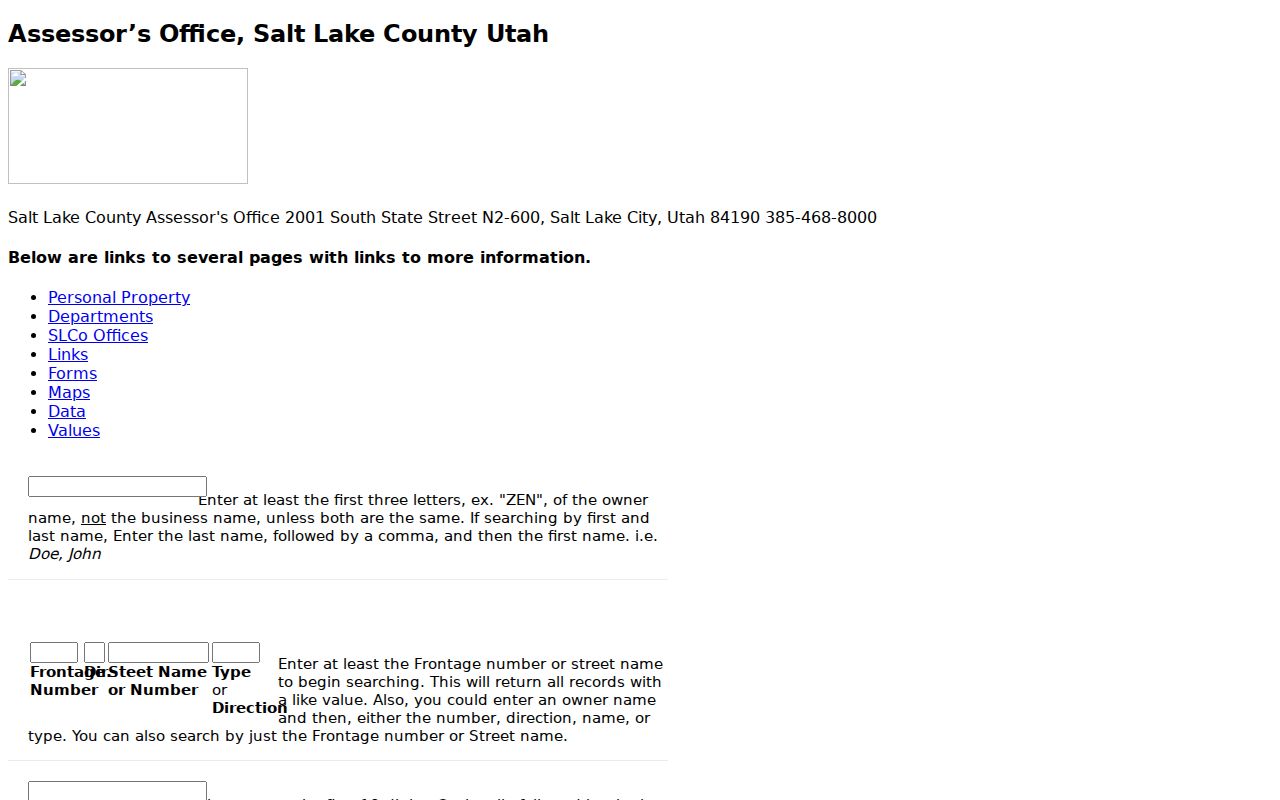
Once a parcel card opens, check the `OWNER NAME` field against the roll date. That date decides what the ownership line can actually prove.
- Parcel / APN
- A county tax and mapping key that joins the map to assessor and tax records.
- Owner of record
- The name displayed in the assessor roll, which can lag a later recorded deed.
- Mailing address
- Where tax notices are sent; it may differ from the property's situs address.
- Assessed value
- A tax-roll amount, distinct from a current sale price or appraisal.
Compare Utah's Official Records With Summaries
When several sources show the same parcel, use the one that owns your field. County systems carry the county's own deed, assessment, tax account, or parcel layer. Commercial data tools mix public sources into shorter summaries. Their update path is harder to trace. Their document source can be too.
| Source | Useful for | Limit to keep in mind |
|---|---|---|
| County assessor | Current owner display, value, parcel number, tax class | Roll timing is not deed timing |
| County recorder | Instrument parties, recording date, legal description | An index entry is not the certified document |
| County GIS / SGID | Location, parcel shape, map layers, cross-county discovery | Reference geometry is not a survey |
| Commercial summary | Quick cross-source orientation | Return to the named custodian to confirm a fact |
Keep a citation to the official record you rely on. Do this for any purchase, tax appeal, or boundary question. When a summary and the source disagree, the record custodian can say which version is current and whether a correction is pending.
Salt Lake's Old Serial Can Link a Parcel Backward
Salt Lake County's historical property-card leaflet tells the story. An older serial or tax number ran through 1983. It may not match the modern APN on the assessor's current page. Record both numbers in your notes. Add the legal description and any deed book/page reference. That older number often helps an archivist or recorder staff member locate a card or deed-book entry after a modern property search returns nothing.
A missing APN is not the end. Subdivisions, lot splits, street renames, and parcel consolidations can all change the key. The assessor card, the recorded plat, and the deed together bridge the number used then to the parcel that exists now.
Utah Tax Records Separate Value From the Bill
Utah's assessor sets the real-property roll from the parcel's status on January 1. Salt Lake County completes the roll in May. Valuation notices follow in July or August. The Board of Equalization appeal window then runs 45 days from the notice mailing. Tax notices go out by November 1. November 30 is the usual payment deadline. A later date can apply when a deadline falls on a weekend or holiday, so the county's live annual calendar is the source for the current year.
Utah's qualifying primary-residence exemption generally applies to 45 percent of fair-market value. The other 55 percent stays taxable. That split is a tax rule. It is not a prediction of sale price. The tax notice reflects the parcel's taxable amount and its local taxing entities, while the assessor's market and assessed fields answer different questions. Review the property type, exemption, district, and value together before comparing one parcel with another.
Delinquency and tax-sale listings are held locally. A tax-sale notice can point to a recorded transfer or redemption event, and Salt Lake County warns that a tax deed does not warrant clear title, zoning, buildability, or habitability. Consult the recorder and a title professional before treating any auction record as proof of ownership.
City Permit Records Add a Building Timeline
Permits, inspections, certificates of occupancy, zoning cases, and plats explain how a building changed or how a lot was planned. A city or county planning office keeps them. The county recorder does not. Salt Lake City's current permit and inspection records date from 1979. Certificates of occupancy start with 2008. Earlier files route through the city's historical records process or a GRAMA request.
Salt Lake City has moved its Accela permit system to the cloud. Searchers are directed to Citizen Access. An old bookmark may no longer work. Check the current portal route first. Pair each permit number and date with the county APN, because a city address or applicant name alone does not establish ownership or title.
Older Utah Property History Uses More Than Deeds
Utah's older property history uses more than deeds. The State Archives land guide covers county and state land records, tax rolls, plats, and federal land-record routes. Salt Lake County's retention schedule names the permanent RC-033 Grantor/Grantee Index, the microfiche RC-048 Deed Books Index, and RC-023 Fee and Entry records. Name the series code in any request. Then add the parcel, old serial, party names, legal description, and approximate year so the custodian has a useful starting point.
Directories connect an address to a year. They also capture a printed name. Utah History's digital collections include city directories. Salt Lake City Library and archives holdings add local directories, maps, and newspapers. The county's property-history leaflet lists fields from old tax cards. Old owner and address information, appraisal, year built, and remarks all appear. Note the collection title, page or box, date, and the printed address exactly, so a later reader can repeat the trail.
Older deeds may not resemble a modern street address. A numbered plat, a Big Field acreage reference, or an old serial can supply the link, but the recorded plat and the deed still control the lot description. A historical map explains it but transfers nothing.
Utah GRAMA Helps When a Record Is Not Online
Utah's Government Records Access and Management Act (GRAMA) is Utah Code Title 63G, Chapter 2. It governs public records requests and access limits. A request goes in writing. Identify yourself. Supply the contact details the law requires. Describe the records with enough detail for the agency to search. Add a parcel or document number, a date range, or a permit number. Include a legal description or a record series when known. State whether you want inspection or copies, and name a preferred format.
The statute sets two response periods: ordinary and expedited. A response is not the same as delivery. The full record set may not be ready that day. An agency may approve the request, deny it, or state that no responsive record exists. It may also give an estimated production date. Inspection is generally free. Copies can carry a fee based on reasonable actual costs. Ask for an estimate first. Direct the request to the office that holds the file. County and city custodians may run a request system separate from the state portal.
The Utah State Archives Open Records Portal serves state entities and related request workflows. It is not a statewide deed-search index. Review the Utah Open Records Portal before submitting a GRAMA request.
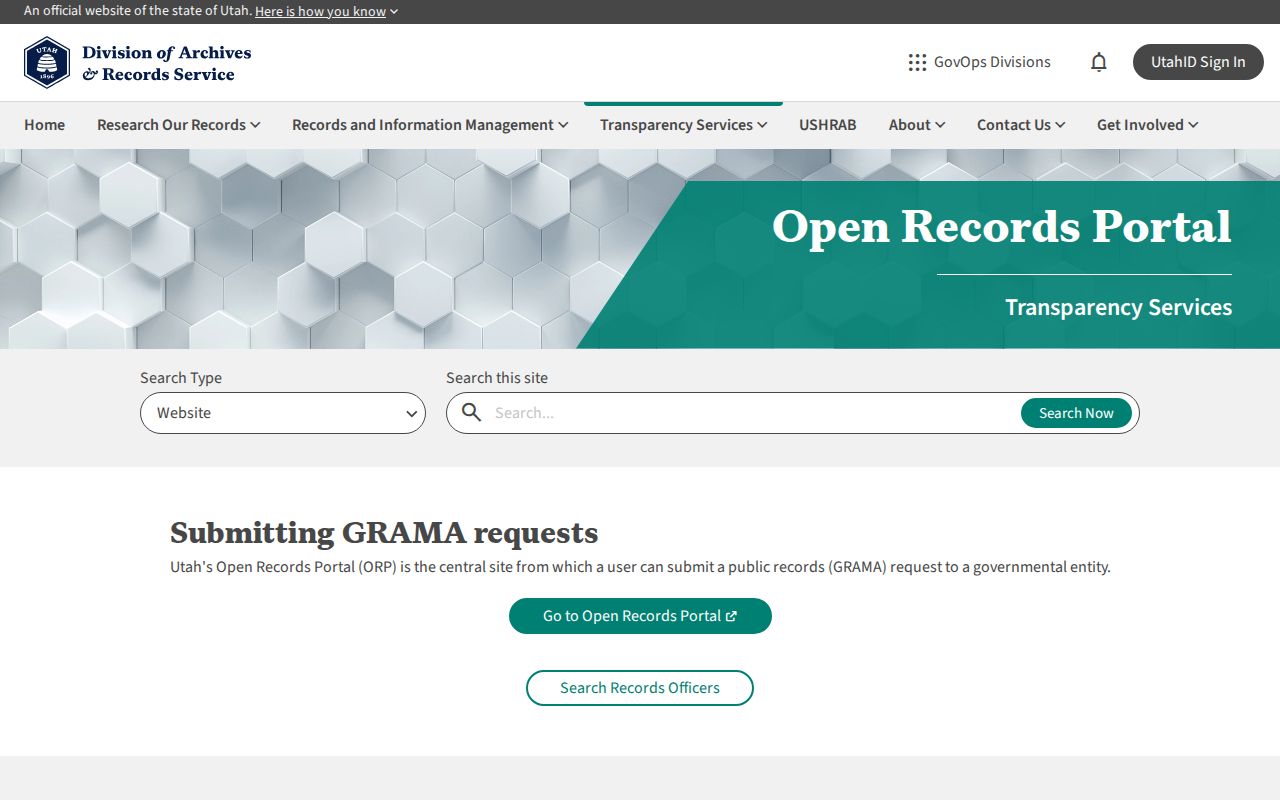
For a deed, assessor card, or tax account, begin with the county office that keeps it. Turn to GRAMA when a government record is not available through the normal public index or portal.
Utah Address Records Have Protected Exceptions
Utah law sorts certain government records into private, controlled, and protected classes. A property record can be public overall. But some personal details inside the document stay restricted or redacted. Court filings carry their own exclusions. An address on a public filing does not prove anyone lives there.
Utah's Safe at Home program offers eligible participants a substitute address along with mail forwarding. The program shields real home and mailing addresses. It also covers city and county of residence, precinct, phone, and unique location details. A substitute address may show up in public-facing records. Do not try to reverse it through parcel clues, voter files, obituaries, or maps. The state's At-Risk voter designation also limits identifying details for eligible voters.
When an online property search comes up short, respect the classification notice. Ask the records custodian what can lawfully be released. A missing name or address may reflect a privacy rule, not a broken record.
What Utah Property Records Leave Open
Public property records can answer plenty. They may show a named owner of record. They may show a recorded deed transfer, an assessed value, a tax balance, a parcel shape, or a permit entry. They cannot prove who occupies a home. They cannot confirm that every interest was indexed. They cannot confirm that a tax balance equals today's payoff, or that a GIS map line is the legal boundary. Trusts and estate representatives can stand in for a person's home address. Entity names and substitute addresses can do the same. Treat an owner search as a starting point for a property question. It is not a title opinion.
Utah protects certain record classes. It runs address-confidentiality programs. When a transaction, boundary, or legal right turns on a record, get the original from the custodian. Bring in a title professional or licensed surveyor when the stakes call for it.
Lawful use. Utah property records support ownership verification, tax review, boundary research, and civic transparency. Do not use owner information to stalk, threaten, or harass anyone; seek a title opinion or survey when the question needs one.