
Utah's Current Owner Field
For a Salt Lake County parcel, the assessor's record uses the label `OWNER NAME`. That entry is defined as the owner of record. It answers a simple question. Who does the county tax roll list today? Treat it as a tax-roll display rather than a live feed of every closing. A trust or company name can appear where a person's name was expected. The same record may also show the legal description, location, sales information, property type, exemption status, and acreage. The exact fields vary by parcel and by how the screen is generated.
| Field | Roll Shows |
|---|---|
| Owner name | The party identified as owner of record on the assessor display |
| Mailing address | Where the roll directs assessment or tax notices |
| Situs/location | The parcel or building location, which can differ from the mailing address |
| Last sale date | Sale data when displayed; confirm the event and recording date in the recorder index |
| Deed reference | Document number or recording detail if the display links or reports one |
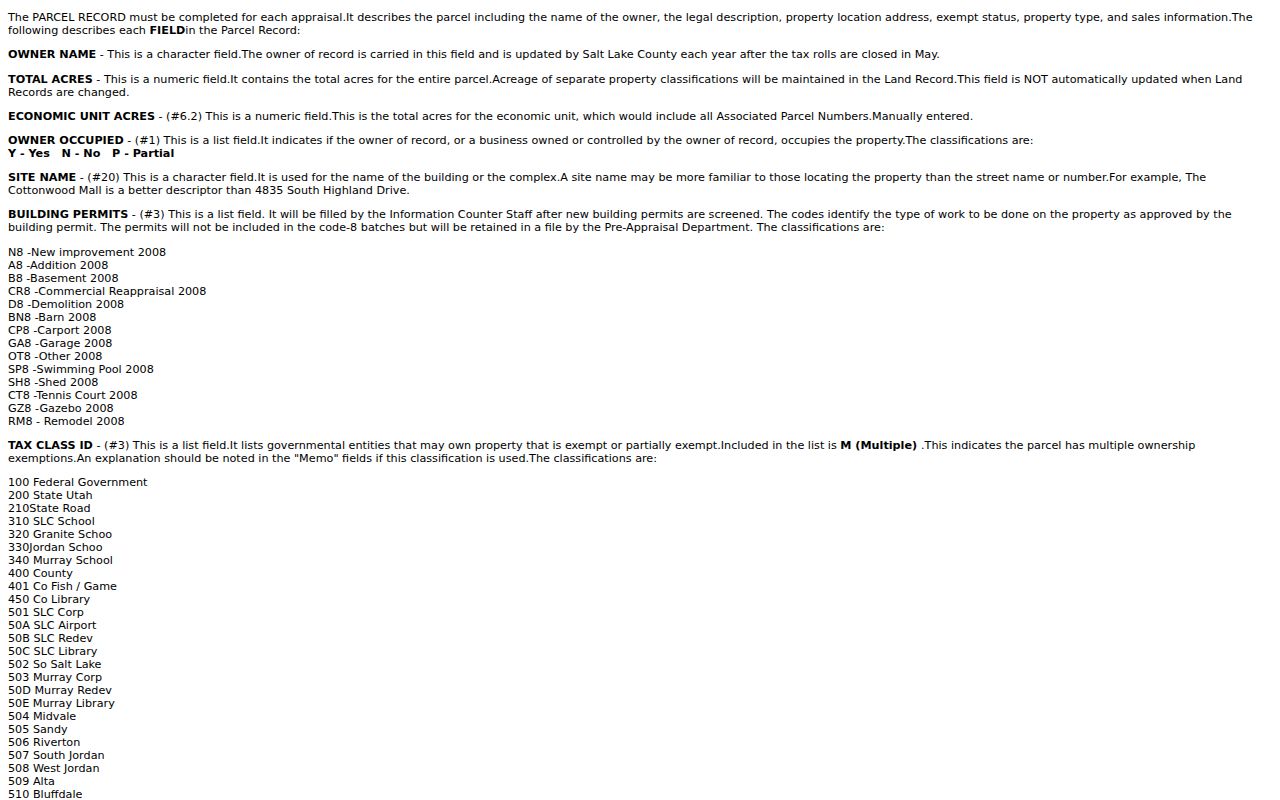
Salt Lake County's parcel field descriptions define `OWNER NAME` as owner of record and explain the annual update note. The page displays that definition for this Salt Lake example.
Other Utah counties may use different labels or field sets. Verify the local assessor's own definition before treating a displayed name as the county's present owner entry.
What Utah Owner of Record Means
Owner of record means the party named in the assessor's roll for that parcel. It answers what the roll says. It does not say who occupies the property. It does not say who manages it or who benefits from an entity's assets. The entry works well for parcel research, tax questions, or a first ownership check. For the transfer itself, the recorded deed supplies the instrument and its vesting language.
- Owner of record
- The name the public assessor roll associates with a parcel.
- Assessment roll
- The assessor's parcel and value record, updated on the county's schedule.
- Vesting / registered agent
- Vesting states how title is held; an agent is an entity contact, not proof of ownership.
- Situs address
- The property's location address, distinct from where notices are mailed.
- Mailing address
- The address used for assessment or tax notices, which may differ from situs.
- Recording lag
- The time between a recorded transfer and a later assessor-roll update.
A mailing address may belong to an agent or manager, and an LLC name may simply be the grantee on the deed. The roll points you to the next lookup. It does not reveal every relationship behind a named party. For the broader route from an address to county records, see the Utah property-owner lookup.
Utah Owner Roll-Close Timing
Salt Lake County updates its `OWNER NAME` field each year. That refresh comes after the tax rolls close in May. A parcel display can stay unchanged after a later sale. That timing is confirmed only for the Salt Lake assessor. Check another county's own refresh note or ask its assessor directly.
Keep the roll or result date beside the name. Label the deed's recording date separately. A current owner lookup needs both sources whenever a transaction may postdate the roll. Without a visible refresh date, call the name the one currently displayed. Do not call it a just-verified closing.
When Deed Beats the Utah Owner Roll
A deed can beat the assessor's owner-of-record field. That happens when it is recorded after the May roll close. For a recent transfer, pull the latest deed. Compare its recording date and grantee against the name the roll still shows. A signing or closing date is not the recording date. Record which date came from which source. The two describe different events and never update together.
Salt Lake County's recorder Data Services search carries a warning. It says property information may be more than 24 hours old. It may also require a title search. That notice covers the service's own data freshness, separate from the assessor's annual owner-field cycle. A just-recorded instrument can be missing from a delayed search result for a short time. An assessor refresh, by contrast, can stay pending far longer.
Use the newest recorded deed for a recent transfer. The assessor roll can lag its May close; the deed's recording date and grantee are the stronger current-transfer clue until the roll refreshes.
Utah Property Owner Addresses
The situs or location address belongs to the land or building. The owner mailing address is where the county sends assessment and tax correspondence. They differ for many reasons. The owner may live elsewhere, use a post-office box, or hold title through a trust or LLC. Some owners rely on an agent instead. A historical tax card can also preserve an earlier appraisal-era owner and address. Check the record date before treating any card as current.
A mailing address is a correspondence route. It is not proof the owner lives there or that the recipient holds beneficial ownership. Compare it with the deed when it matters. Do not infer a protected residence from other records.
Confirm the Utah Current Owner
To confirm a present owner listing, start with the assessor record. Then check the recorder for the most recent deed. It should be tied to the same parcel or exact legal description. A deed names the grantee and states how title is conveyed. This is a targeted confirmation of the current transfer, not a backward chain search. If the sources disagree, compare dates. Note that the county roll may not yet reflect the newer recording.
- Open the parcel in the county assessor system and save its owner name, APN, situs, mailing address, and result date.
- Use the parcel, legal description, or address in the county recorder's public search and select the matching property.
- Review the newest deed's document type, recording date, grantor, grantee, and vesting language.
- Compare the grantee with the assessor entry, noting any difference and the date each system reports.
Salt Lake County's Data Services public search accepts an address or parcel selection. The county lists a $5 option for 24 hours and up to 150 Data Units. Under the service agreement its data is not official or certified, so request the recorded copy from the custodian when formal proof is needed.
Utah LLC and Trust Owner Names
A parcel's owner of record is not always a person. The tax roll may name an LLC, a trust, a trustee, or an estate. It may also list a personal representative instead. Start with the exact wording as printed. If the assessor or recorder returns nothing, try punctuation and entity-suffix variants. A company can also carry a former name. Its public filing address may differ from the parcel's situs. Never assume a registered agent owns the property or benefits from the entity.
Utah's Business Registration system helps confirm a company's identity. It also shows the standing of a company named in a deed. That filing is separate from the property instrument itself. For title questions, the deed's grantee and vesting language control who took title. An entity filing may explain the company. But it proves nothing about beneficial ownership.
Keep a representative or estate name exactly as printed. The deed states the grantee's capacity. If that language is unclear, ask a title professional or attorney. Do not infer ownership from an address or business record.
Utah Owner Records and Deed Dates
Write down the document number, recording date, instrument type, grantor, grantee, and full legal description. Those details let you find the deed again. Compare any assessor sale reference against the recorder index before trusting it. Two screens can look alike yet describe different transactions.
Salt Lake County's sample result shows the parcel, address, document count, and legal description. It also lists document numbers and dates, document types, and the displayed owner. It is one example, not a promise for every parcel. Match the legal description before treating different address text as an ownership change. Match the parcel number too. An index may point to an image that is separately gated.
Utah Owner Records and Privacy
Many assessor and deed fields are open to the public. Related details, though, can be private, controlled, or protected, and recorded documents sometimes carry redactions. Keep a Utah property lookup tied to the parcel and its ownership record. Adding unrelated personal details serves no purpose.
Utah's Safe at Home program gives eligible survivors a substitute address with mail forwarding. Home and mailing address stay protected. City or county of residence, voting precinct, and phone number do too. Unique location information is also shielded. At-Risk voter records receive restricted treatment as well. The assigned address offers no location clue. Do not try to reverse these protections through assessor, recorder, voter, obituary, or map records.
Utah Owner Record Versus Legal Title
The assessor field answers one question: who does the tax roll list for administration. The deed records a transfer and names the grantee. Neither a parcel result nor a map popup amounts to a title opinion. Salt Lake County's recorder states plainly that it does not determine clear title. Liens, easements, or other instruments can change what an owner entry really means.
When you need formal proof, order the official instrument. Ask the recorder for a certified copy. Salt Lake County prices ordinary copies at $2 per page and certified copies at $5 plus $2 per page. Confirm current fees first. For older index or image questions, the Salt Lake County Recorder sits at 2001 South State Street, N1-600, Salt Lake City. It is reachable at 385-468-8145, Monday through Friday, 8 a.m. to 5 p.m. For the full instrument workflow, see Utah deed records. Consult a title professional when a legal decision hangs on the answer.