
Utah Property Tax Record Fields
Utah keeps no single statewide parcel tax account in place of county records. Each county assessor holds the parcel and valuation roll. The treasurer or auditor handles bills and payments. That same office tracks delinquency and tax sales. State standards apply across Utah, but parcel fields and bill routes remain local. Start where the land sits. Then pick the record that matches your question.
| Field | What It Shows | Where to Check |
|---|---|---|
| Parcel, situs and legal description | Which land account the tax entry refers to | County assessor |
| Market and assessed value | The county's valuation and roll amount for the year | County assessor |
| Exemption, property type and tax class | Classification or relief reflected on the parcel record | County assessor |
| Tax district and levy detail | The taxing units that contribute to the bill | County notice or treasurer |
| Amount due and payment status | Current charge, payments and delinquency status | County treasurer or auditor |
| Sale, redemption or tax deed | Collection and post-sale events tied to the parcel | County tax-sale page and recorder |
Treat these as record groups. That is not a promise that every Utah county uses the same labels or posts every item online. Salt Lake County's assessor card shows exempt status, property type, and sales information. The treasurer lookup there covers payment. Other counties split the work among an assessor, treasurer, auditor, or a combined office.
Read the assessed or market figure as an assessor record. Read the bill as the charge after local tax and exemption rules. A tax-record number is not a sale price. The separate Utah property value comparison explains value labels.
Find a Utah Tax Parcel
Start with an address to locate the parcel. Save the full parcel number before checking a tax bill. Salt Lake County's Treasurer parcel lookup accepts an address or a parcel number. It then asks users to select the matching address. That field behavior belongs to one county, not a statewide format.
| Lookup field | Observed behavior | Useful next step |
|---|---|---|
| Address | Enter the parcel address and select its offered match | Confirm the parcel number before checkout |
| Parcel number | Salt Lake County's payment page shows 00-00-000-000-0000 or the extended 00-00-000-000-0000-000 form | Reuse the full APN on later county searches |
| Date for balance | The payment page says this checks a future balance, not a scheduled future payment | Keep the balance date separate from the payment date |
- Confirm the county from the parcel's situs location; a postal city may not identify the tax office.
- Search the assessor by address or parcel, then copy the full APN and legal description.
- Open the treasurer or auditor lookup, select the parcel, and review the tax year, amount due and status.
- Assessed value
- The county's roll value for a tax year; it is not automatically the amount due.
- Taxable value
- The value to which the applicable local tax rate is applied after exemptions allowed by law.
- Levy or tax rate
- The rate adopted by taxing entities and shown through the county tax notice; local units can differ.
- Primary residential exemption
- A Utah tax exemption that generally leaves 55% of fair-market value taxable for a qualifying primary residence.
- Tax lien
- A claim that can arise under tax law when property taxes remain unpaid; check the county record for status and later events.
A Utah parcel number is a stronger cross-reference than a street label. Formats vary by county, though. If an address returns more than one account, compare the legal description and parcel map before paying or requesting a record. Compare the legal description. Then check the parcel map before paying or requesting a record.
Note: Keep the assessor's value year and the treasurer's bill year together. Compare entries from two county screens with both years in view.
Utah Assessed and Taxable Values
Utah's real-property valuation standard describes fair-market valuation. The roll and the bill answer separate questions. Assessed value is the amount on the annual roll. Taxable value is what remains after a lawful exemption. The tax notice shows local levies and the charge due.
Salt Lake County's CAMA parcel-data description lists tax class, property type, district, exemption type and percentage, new-growth year, and reappraisal-override fields. That bulk data product sits apart from an ordinary parcel lookup. Its labels are not a statewide bill format. The standard parcel card carries a shorter field set.
Utah's Primary-Residence Exemption
Utah's residential exemption is a tax treatment, not a discount from a sale price. A qualifying primary residence generally has 45 percent of fair market value exempted. That leaves 55 percent taxable. The change affects the tax calculation only. It does not mean the home is worth 55 percent of market value. The assessor's estimate should not be divided by a fixed ratio either.
The state information describes a 183-consecutive-day primary-residence condition for qualifying part-year residential property. It adds land and unit limits, plus statutory exceptions. Check the parcel's exact status on its county assessment notice or with the county assessor. Salt Lake County's card can show exempt status. That one example does not describe how every Utah county labels or administers an account.
If a notice seems to omit a claimed exemption, compare parcel, year, and status first. Then follow the assessor's current instructions. Never infer eligibility from a mailing address or another owner's prior bill. Utah's residential exemption information explains the statewide rule.
Pay a Utah Property Tax Bill
The Salt Lake County parcel lookup asks for an address or parcel number and shows how the address choice is confirmed before checkout.
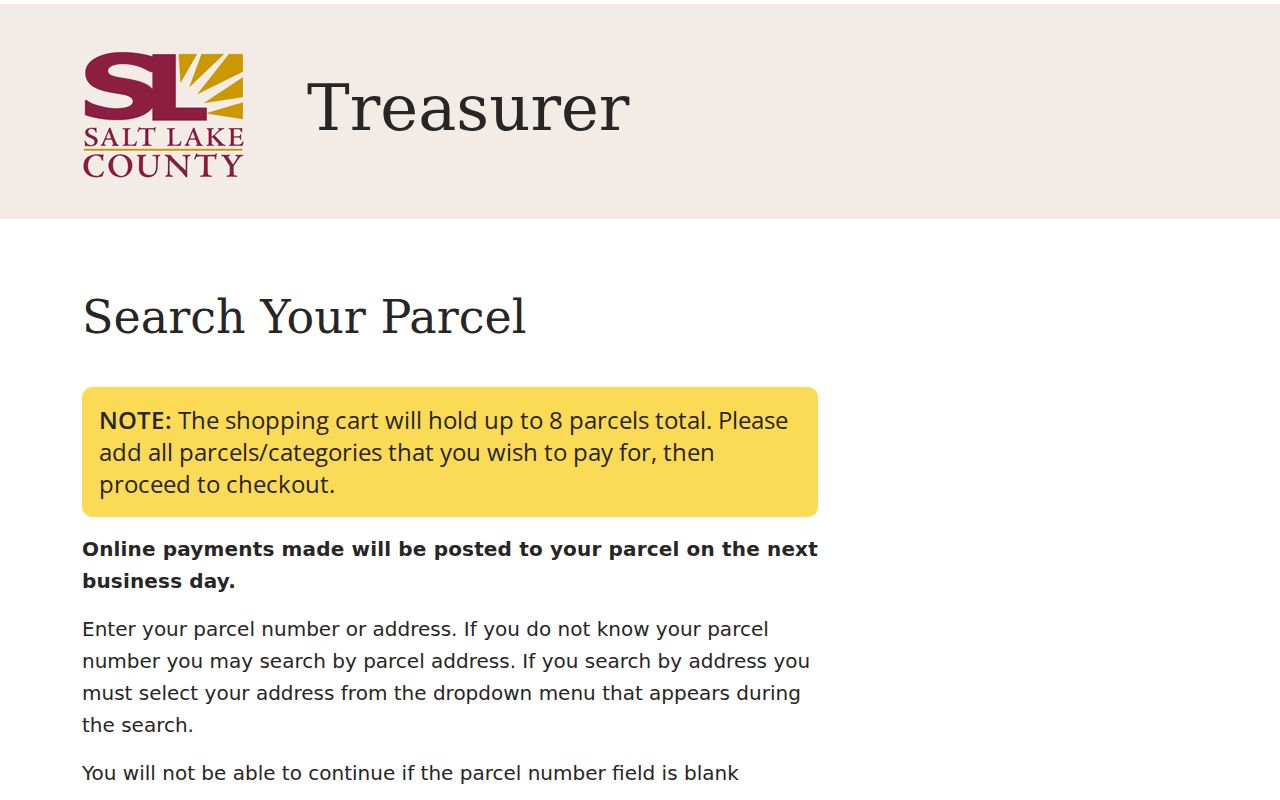
The Salt Lake County treasurer's payment page states that online payments post to the parcel on the next business day. The shopping cart can hold up to eight parcels. A balance viewed on the payment date may not yet reflect a recent online payment. Keep the receipt and check the account again after posting.
Salt Lake County offers online payment by mail with the notice stub. It also takes in-person cash or check payment with the stub. It lists phone and email contacts for questions and an email option for tax notices. Its property tax services page carries current details. Other counties may use different routes or processing times.
Utah Assessment Appeal Timing
A value appeal targets the assessor's market-value conclusion for the parcel and tax year. It is not a request to change the tax rate. A bill dispute belongs with the office that handles the bill. Utah's county Board of Equalization process and filing window run locally. The notice is the key paper. It names the parcel, the proposed value, and the deadline for that cycle.
Salt Lake County's published deadline is 45 days from the valuation notice. Or it is September 15, whichever is later. The county's live appeal instructions and the notice control later cycles. Salt Lake accepts appeals online, by email, by mail, or in person. Late appeals follow separate criteria and are not an automatic extension.
Build evidence around the value on January 1 of the year under review. Salt Lake County asks for the parcel number, address, proposed county value, and owner's proposed value. Supporting documents go with the form. Comparable sales near the valuation date may help. Follow the county form and keep proof of filing.
Check the notice before filing. Appeal deadlines and accepted late-filing grounds are cycle-specific. A past Salt Lake County date is not a deadline for another Utah county or tax year.
Note: A valuation appeal challenges the amount on the notice; payment or posting questions belong with the county treasurer.
Utah Delinquent Tax Sale Records
Delinquency moves through distinct stages. An unpaid balance comes first. Then a sale list is published. Finally a tax deed gets recorded. Salt Lake County's tax-sale page explains its sale and redemption process, while the county recorder holds the deed once a sale completes. County sale dates advance each year and published lists get updated, so the live list controls current parcel status. The Utah deed guide explains how to trace the recorder record after a transfer.
| Record | What It Can Show | Check |
|---|---|---|
| Delinquent balance | Parcel, tax due and payment status | County treasurer lookup |
| Sale listing | Parcel, address, scheduled sale and delinquency notice | Live county sale list; confirm updates and redemption |
| Tax deed | Recorded deed number, date and grantee after a sale | County recorder index and instrument |
Salt Lake County warns that tax-sale property sells as-is. The county's tax deed carries no warranty of title, buildability, zoning or habitability. A sale entry should prompt a redemption check and a recorder search. It does not prove a parcel is abandoned. It also does not prove the parcel is free of other interests. Read the county's sale procedures alongside the live list.
Utah Tax Calendar Example
Annual dates matter here. They explain why the assessor record, the appeal notice and the payment portal change at different points in the year. Salt Lake County's dates and deadlines calendar is a clear example. Valuation date is January 1. The roll is completed in May, with valuation notices mailed in summer. Tax notices go out by November 1. Current-year payment is due November 30. The same calendar marks December 1 delinquency and the Board of Equalization window. These dates belong to Salt Lake County, not a statewide schedule.
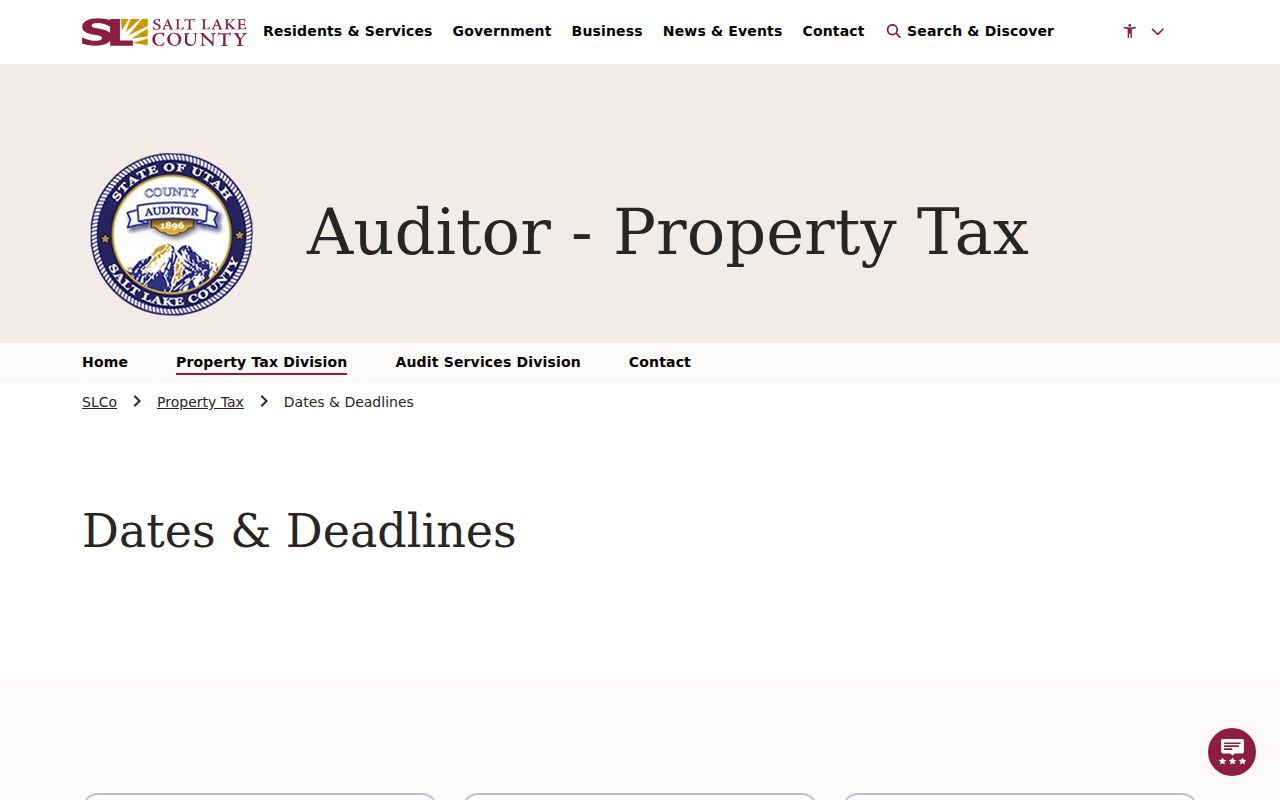
Salt Lake County publishes an official dates-and-deadlines page for the tax year. Check the current schedule first. Do not rely on a notice or filing date without it. Confirm any sale date or payment date the same way. Other county calendars can differ in how they present the same statutory steps.
Counties administer locally assessed property taxes and handle parcel bills at the local level. Use the county's notice for the dates that apply to one account.
Request Missing Utah Tax Records
When a county portal comes up empty on tax history, go straight to the people who hold the records. The assessor keeps valuation and exemption files. The treasurer or auditor handles bills, payments, and delinquency. Have a parcel number, the address, the tax year, and the exact record you want ready before you call. Salt Lake County's historic property-history leaflet points out that older property cards can list an appraisal date, an old tax number, the owner at appraisal, the address, and remarks. A card missing from the portal may still exist through a separate archive route.
Utah's Government Records Access and Management Act gives you a written-request path for anything not online. Name the agency, the parcel, the date range, and the format you prefer. The State Archives' Open Records Portal is one way in. Counties may run their own portal with their own fee policy.
Utah Code section 63G-2-204 sets the clock: ten business days for an ordinary request, five for an expedited one that qualifies. The response might approve, deny, report no record, or give a production estimate. It does not have to deliver every page by that date. Fees usually track reasonable actual costs, so get an estimate first.
Note: Ask the record holder for a cost estimate before ordering a large batch of tax images, bulk data, or older records.