
Find Who Owns a Utah Property
Curious about who owns a property in Utah? Start with the county assessor's parcel record. Compare the owner-of-record name against the newest recorded deed in the recorder's files. If an address comes back empty, search by parcel number or owner name instead. Companies, trustees, and estates often hold title rather than individuals. A mailing address may differ from the parcel's physical address. A public record never proves who actually lives there. For deeper answers, you can search Utah property records by county. None of this replaces professional title work.
- Search the county assessor by situs address or parcel and copy the owner name exactly as shown.
- Compare the APN and legal description with the latest deed in the county recorder index.
- If the owner is an entity, look up that exact filing name in Utah's business registration records.
- Use the mailing address only as a notice address, and respect any privacy classification.
Utah Property Ownership Sources
No single record tells the whole ownership story. The county assessor lists the owner of record on the tax roll. A recorded deed, by contrast, names the grantee in a transfer. That is the stronger evidence of who took title. The GIS map is handy for locating the parcel. It is not a title record. Business filings show an entity's public registration. They do not reveal every person who benefits from property held inside that entity.
| Source | Owner Info It Gives | Access |
|---|---|---|
| County assessor roll | Displayed owner name, mailing address, parcel, and value fields | County parcel search; counter or records request if needed |
| County recorder | Grantee and grantor on a recorded deed, plus its legal description | County index, Data Services, office, or copy request |
| Utah Business Registration | Public entity filing, status, registered agent, and addresses shown | State business-entity search |
| County GIS / Utah SGID | Parcel location and generalized map attributes | Map viewer or statewide data service |
The owner of record is the party a property record names as holding the recorded interest. Living in the house does not make someone the owner, and a mailing address on the tax roll is not always the parcel's physical location. Keep that distinction in mind when you search.
Keep the Utah Parcel and Legal Description
An address reads easily but can change, run incomplete, or sit on a city or ZIP edge. Save the county APN and the legal description alongside it. Salt Lake County's assessor search accepts an address, an owner, or a parcel number. Its recorder Data Services search, meanwhile, starts from an address or parcel autocomplete. The APN is the practical bridge between assessor and deed records. Just remember that a split, merger, or replat can change it. Before treating two search results as one property, compare the legal descriptions. A lot-and-block description points to a recorded subdivision plat. An older rural or mining claim may rely on metes and bounds instead. The recorder's deed and the final recorded plat carry the official wording; a map popup or a shortened assessor label is only a pointer.
Read the Salt Lake Assessor's Owner Name
Salt Lake County calls its owner-of-record field `OWNER NAME`. The entry might be one person. It could be joint owners, an LLC, a trustee, or an estate representative. Either way, the assessor roll is only reporting the name carried on the tax roll. It does not tell you who actually lives at the parcel. The county updates that owner field once a year. The refresh comes after the tax roll closes in May. A deed recorded after that cycle may not appear until the next refresh. The field descriptions and parcel-card labels appear below. This example comes from Salt Lake County. Other Utah assessors may use different labels or refresh their rolls on another schedule. Review Salt Lake County's parcel record field descriptions for the meaning and update note on `OWNER NAME`.
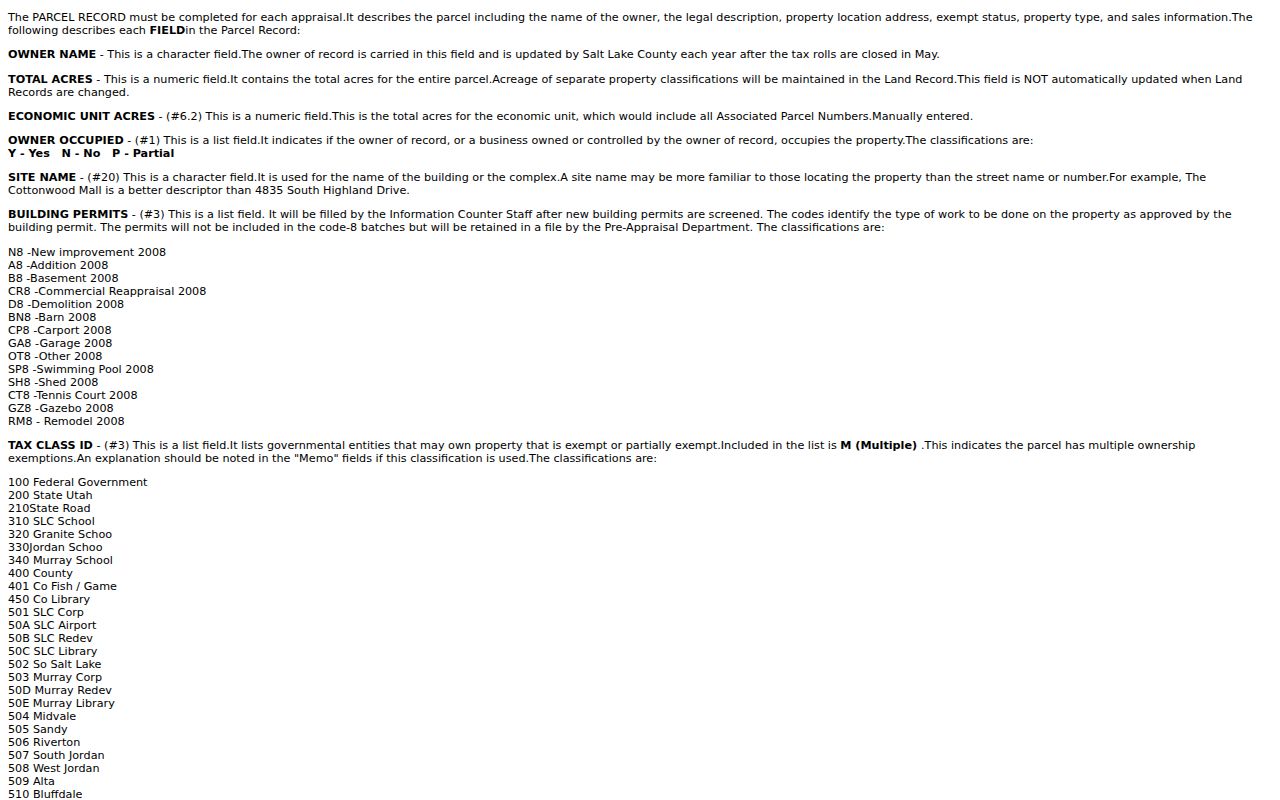
Treat the field as a starting point for the deed index. If the transfer looks recent, compare the assessor's date with the recording date before trusting the displayed owner as current.
Confirm a Utah Owner With the Latest Deed
The newest recorded deed reports the latest conveyance. Pull the grantor and grantee names. Note the recording date, the instrument or book/page reference, and the legal description. Then confirm the deed's legal description matches the assessor parcel. Deeds get recorded as they happen. The assessor display waits for its yearly cycle, so a fresh deed can outrun the annual owner field. Even so, a deed alone cannot clear every lien. It may not clear exceptions or unrecorded claims against the title.
Salt Lake County's Recorder holds deeds, mortgages, liens, plats, and related instruments. Its Data Services public search locates documents and parcel history by address or parcel number. The service cautions that some public information may lag more than 24 hours. It also cautions that a title search may still be needed. Other Utah counties offer their own counter, mail, or online routes to deed records. For instrument types and copy procedures, see Utah deed records.
If an online image is unavailable, record the document number and recording date. Then ask the recorder for a plain or certified copy. Never substitute a map label or index summary for the deed's actual vesting language.
A Utah Entity Name Has Its Own Limits
An LLC, corporation, trust, or estate on an assessor or deed record is not a person. It is a legal name. Look up that exact name in Utah Business Registration, the state's official entity search. The filing may list entity status, a registered agent, officers, and addresses that are public. One caution matters here. A registered-agent address is a business contact. It proves nothing about where the agent lives or whether the agent owns the parcel.
Entity filings and deed records answer different questions, and the gap between them is real. The deed names the grantee who took title to the property. The entity page describes the organization itself. Neither document names every beneficial owner. A member's name may appear in some filings but not others. For a trust, work from the recorded instrument. Beneficial rights are a legal question, so seek advice from a lawyer.
Separate a Utah Situs Address From Mail
A situs address tells you where the parcel sits. The assessor's mailing address tells you where notices go. That mailing address may be a post-office box, an agent, an out-of-county location, or a protected substitute address. None of that means the record is wrong. It just reflects how the two fields work.
Utah's Safe at Home program shields actual residence and mailing details for eligible participants and supplies a substitute address for official use. At-Risk voter records get similar restricted treatment. If the records show a substitute address, or the custodian says the information is protected, stop there. Do not try to piece together other sources to infer where someone lives.
Utah Estate Changes May Need Court Records
Ownership rarely changes on paper the moment someone dies. In Utah, the transfer may surface later as a probate order, a representative or distribution deed, a survivorship instrument, or a follow-up conveyance. A death certificate helps frame an estate question. It does not move title. The recorded instrument is what carries the property to the new owner of record.
Utah Courts Xchange lets the public search probate and property cases by party or case number, and its results can point toward a case file worth ordering. Sealed and protected matters stay closed to the public. Utah Courts Xchange shows filings, though. It is not a substitute for the deed itself.
Older Utah death records work differently from modern ones. The state vital-records office, the county clerk, the district court, and the State Archives each cover their own date ranges, and recent certified copies carry eligibility and identity requirements. Establish the transfer with the court order or recorded deed first. Treat the vital record as supporting context after that.
What a Utah Owner Search Cannot Prove
A name that comes back from a Utah owner search is just that. It is the party listed in that source at that point in its update cycle. It does not prove anyone lives at the address. It cannot confirm an entity's beneficial owner. And it never guarantees that every lien or competing claim has surfaced. A title search examines the full recorded chain and its exceptions, and that work belongs to a professional.
Utah also shields some details on purpose. The Safe at Home program and At-Risk voter status keep certain identifying information protected. Sometimes a mailing address is substituted for a residence. Home addresses and unique location details can stay out of view. Parcel clues and voter rolls should never be pieced together to rebuild a protected location.
Lawful use. A Utah owner lookup is for property diligence, recorded ownership checks, and civic research. Do not use an owner's information to stalk, threaten, or harass anyone.