
Trace Former Owners in Utah
Work backward, one recorded deed at a time. Start with the newest transfer, then use its grantor and legal description to locate the prior deed. Repeat that step. Continue until the online index ends or an older book reference takes over, copying fields from the worksheet rather than a sample transaction.
| Transfer Date | Grantor → Grantee | Deed Type | Book/Page |
|---|---|---|---|
| Date printed on newest deed | Party names exactly as indexed | Type shown on the instrument | Instrument number or book/page |
| Date on prior deed | Earlier grantor → grantee | Type shown on the instrument | Copy the older reference |
| Date in ledger entry | Names as written in the index | Type or entry notation | Volume/page and series |
Open with the online index or parcel history. If an image is missing, use its instrument number to request a copy or an inspection. When the party index stops, ask for the older deed-book or ledger series. Tax cards bridge old parcel numbers. Neither replaces the deed. Compare each transfer's legal description and parties before adding a name to the chain, since a matching street address alone proves nothing.
Start With the Newest Utah Deed
Start with the county assessor. It identifies the parcel and legal description, and the latest deed then sits in that county's recorder index. Salt Lake County's parcel search and Data Services follow this route, and the Utah property-search guide explains how to begin with the county roll. The assessor's owner field refreshes on its own schedule. The deed's recording data anchors the older chain.
Search tools and index depth differ across Utah counties. The county recorder index links to local offices. Confirm the situs county, then save the address, APN, legal description, parties, type, and recording reference together.
Salt Lake County's public search shows the address or parcel entry:
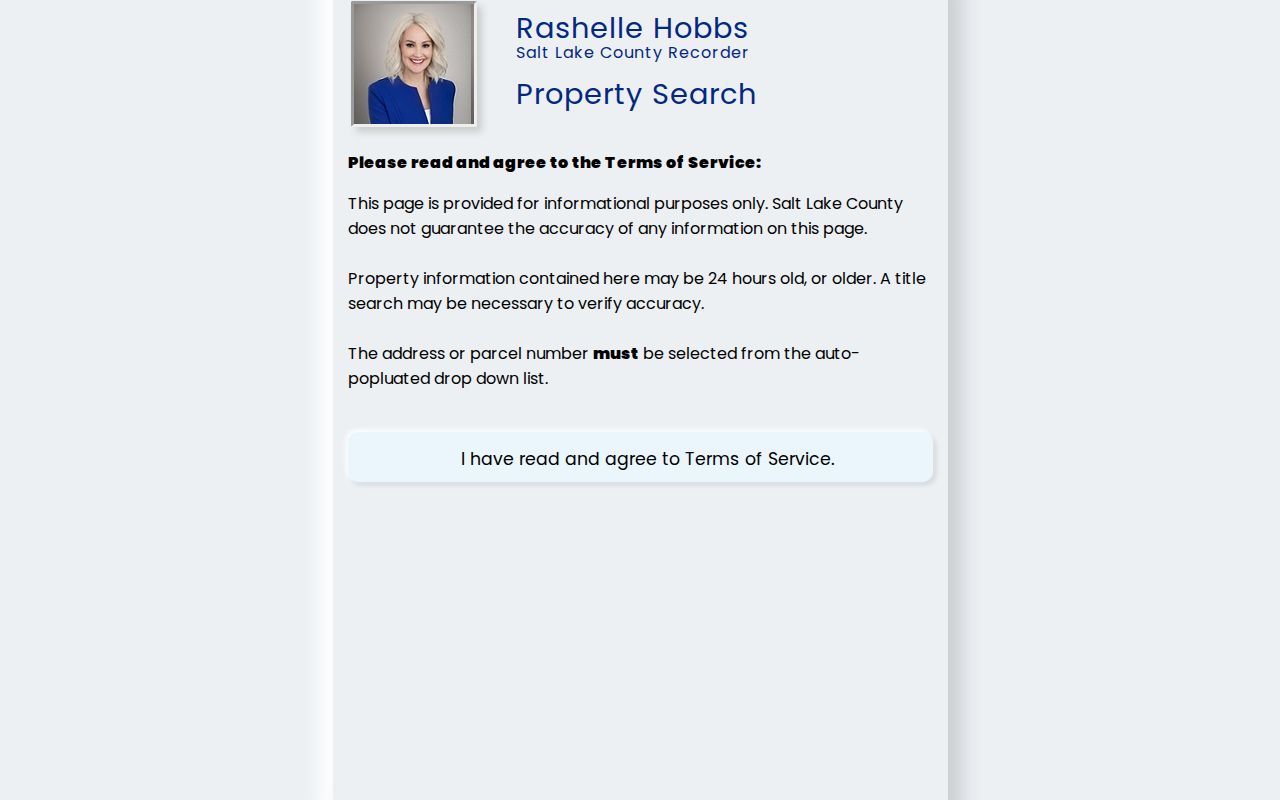
Picking the right parcel is only the start. The legal description and recorded instrument are what tie that result to the older chain of deeds.
Read Utah's Deed Chain Backward
Work from party roles, not names in date order. Salt Lake County's permanent grantor/grantee index records parties, dates, type, description, and volume/page. Check the parcel at each link. Check the legal description too, and if a gap appears, investigate an index issue, a parcel change, or a non-deed event rather than guessing.
- Copy the latest deed’s date, reference, parties, and legal description.
- Search its grantor as a grantee, using the same land description.
- Verify the earlier deed connects the same land and party.
- At the online cutoff, follow the older book or microfilm reference.
- Grantor / grantee
- The conveying party and recipient; roles can change in the next deed.
- Chain of title
- Linked conveyances and title events for the same land.
- Reverse index
- A path from a later grantee back to the prior deed’s grantor.
- Quitclaim / warranty deed
- Different forms of conveyance; read the instrument for the interest and warranties stated.
Separate Utah Former Owners From Other Filings
Recorder histories hold more than deeds. Mortgages, assignments, releases, plats, liens, and judgments can sit between transfers. Salt Lake County's RC-033 and RC-023 series show why type and party role matter, since not every indexed entry names a former owner.
Record non-deed filings as context. Then find the conveyance connecting grantee to later grantor. A quitclaim records only the signer's stated interest, not proof of full title, and the Utah deed records guide covers instrument types and copy routes.
Utah Former-Owner Index and Image Cutoffs
A 2006 audit maps Salt Lake County's cutoffs. Handwritten ledgers run before 1981, mainframe indexes begin in 1981, and online images reach back to about February 1985. These are separate cutoffs. An indexed name may still point to a deed kept on microfilm.
The audit does not guarantee completeness. Nor does it set Utah-wide coverage, so ask each county when its index and images begin, and note the county and record series beside every date.
Index date versus image date. A Salt Lake County index hit may be older than its online image run. Save the reference and ask the recorder or archive for the page.
Find Older Utah Deed Books
In Salt Lake County, anything recorded before 1981 lives in a different world from the online index. You move from a screen result to a handwritten ledger, a deed book, or microfilm. RC-033 and RC-048 sit as separate series. The deed-book index may be organized by parcel or owner, legal description, tax ID, acreage, or book and page. Call the recorder at 385-468-8145, or ask county archives staff, to identify the right run and how to reach it.
To inspect or copy a volume, file a written GRAMA request. Include the parcel, legal description, parties, approximate year, series code, and the format you want. State Archives guidance lists the required details and response targets, though counties may use local portals. Ask about copy fees and mailing instructions before sending payment; a uniform mail-in deed-copy form is not published. The Utah Archives land guide covers archive routes. If the county portal cannot find a volume, give staff the retention-series name instead of asking them to hunt through all old deeds.
Mining-era land adds another layer. The county finding aid describes a Bingham abstract journal covering 1855-1951 and 5- or 10-acre records from 1891-1923. Those entries may rest on claims or acreage descriptions rather than a modern parcel number. Compare the mining-record series against the later legal description and recorded plat to bridge the land into a parcel you can trace today.
| Record layer | Salt Lake County time clue | Where to continue |
|---|---|---|
| Mainframe grantor/grantee index | Back to 1981, with series completeness to confirm | Recorder search or staff query. |
| Document images | Approximately February 1985 and later | Online image, copy request, or older book reference. |
| Earlier index and deed books | Handwritten before 1981; exact runs vary | Recorder vault, county archives, or transferred microfilm. |
Bridge Utah's Old Parcel Numbers
Old Salt Lake County tax cards hold a wealth of clues for a property search. Each card gives the owner at appraisal, the address, the old serial or tax number, the appraisal date, the year built, and remarks. The county relied on those serials through 1983. Keep one next to the current APN, since mailing and situs addresses can differ. The county's property-history leaflet shows which card fields matter.
Parcel keys also shift over time. Replats, splits, consolidations, and street changes can all alter a parcel number, so search by plat name, phase, lot, and block as well. Salt Lake City's Atlas Plat Index untangles older street and lot references, while the recorded deed supplies the actual conveyance.
Trace Utah Estate Deeds
Estate transfers often surface a new name in deed records. A personal representative, executor, trustee, or administrator may sign on the decedent's behalf. Search the decedent, the estate, the representative, and any later grantee when the record allows it.
Match the probate case against the deed. The legal description should agree, and the signer's stated role should fit the transfer. A death certificate helps the search but does not convey land. Salt Lake probate indexes cover 1876 through 1979. The territorial Third District case-file index runs from 1871 to 1896. Use Xchange for current case records. Then ask the State Archives about the older index and file access.
Build a Utah Property Timeline
A gap in a deed chain is not the end of the trail. Libraries can explain an address change or a name variant that broke the sequence. Salt Lake City Public Library Archives holds newspapers, maps, clippings, legal material, and microfilm. Sanborn maps cover Utah cities from 1867 through 1970. Historic directories help track an address across decades. Remember, these sources add context, not conveyances.
Log every clue carefully. Record the year, issue date, page, map sheet, and exact address with each find. A directory entry or obituary cannot prove a deed. Check the library's archive catalog for holdings and in-person access. Polk city directories after 1924 added address-order pages, which can make earlier address tracing harder. For land origins, turn to the State Archives land guide; a federal patent is not part of the current chain of title.
How Far Back Utah Deed Chains Reach
Utah deed chains have no single online cutoff. Nor is there a uniform depth to how far they reach. County record series differ, and a first online hit is rarely a property's first deed. In Salt Lake County, older ledgers and microfilm extend beyond the mainframe index. The image run, though, begins later than the text.
History shapes what survives. The Salt Lake County Recorder traces its office to 1850, and Salt Lake City Recorder records moved to the county on April 5, 1867. A federal patent marks an earlier land transfer, not the current chain. A gap alone cannot tell you whether an index, a transfer, or a missing document caused the break. Save the last confirmed link and ask the archive which series follows.
Lawful use. Former-owner research is suited to house history, title work, and property diligence. Do not use public records to track, threaten, or harass a living person.