
Utah Deed Records by Instrument
County recorder filings across Utah mix several deed types, and the instrument's name carries real meaning. A warranty or grant deed documents a conveyance. A quitclaim moves only whatever interest the signer holds. Trustee and personal-representative deeds mark a fiduciary transfer. None of the labels proves the signer held good title, so read the parties, legal description, signatures, and recording reference before drawing conclusions. Treat these common patterns as guidance, not a promise that every deed works alike.
| Deed Type | What It Does | Common Use |
|---|---|---|
| Warranty deed | Conveys the stated interest with the warranties written in the instrument. | Reviewing a conventional transfer and its stated protections. |
| Grant deed | Records a conveyance; read the text for the promises and exceptions it makes. | Following a sale or other transfer. |
| Quitclaim deed | Transfers whatever interest the signer has, without establishing that the signer owns more. | Family, co-owner, or title-interest changes. |
| Trustee or personal-representative deed | Shows a conveyance signed in a fiduciary role. | Trust, estate, or some sale proceedings. |
| Tax deed | Records a tax-sale conveyance when one is issued and filed. | Checking a tax-sale property’s recorded history. |
Recorders in Utah keep far more than deeds. Mortgages, liens, judgments, easements, releases, assignments, mining instruments, and subdivision plats sit nearby in the same files. A mortgage records a security interest, a release can mark its discharge, and a plat lays out lots or streets. Read the type before assuming a transfer. The instrument label matters. Salt Lake County's tax-sale rules warn that a tax deed is sold as-is, with no guarantee of clear title, buildability, zoning, or habitability.
Utah Grantor and Grantee Indexes
Grantor means the conveying party. Grantee means the recipient. Utah indexes pair those roles with date, document type, property description, and a volume/page or instrument reference, as Salt Lake County's permanent RC-033 series shows. It is not a list of owners. A name may sit on a mortgage, release, lien, or plat as easily as on a deed.
Salt Lake County's Data Services public search opens with address or parcel autocomplete, a matching selection, and terms. Its deeper service covers recorded documents, parcel history, legal descriptions, and chain-of-title information. A statewide grantor/grantee form does not appear there. So check the situs county's own recorder instructions. Keep instrument numbers, dates, and party spellings as indexed. The county's permanent index also stores description and volume/page details that bridge to older entries.
| Search entry | What the inspected route uses | How to read the result |
|---|---|---|
| Address | Autocomplete; select the matching property. | Useful start, but compare the parcel and legal description. |
| Parcel | Enter or select the parcel record. | Carry the complete parcel identifier into related county records. |
| Owner or document history | Available through deeper Data Services features. | Check party role, filing type, date, and image access. |
- Match the parcel or address to the recorder’s county index.
- Search a party as grantor or grantee, following the role shown in the instrument.
- Compare document type, recording date, legal description, and instrument reference.
- Open the image if available, or use the reference to ask the recorder for a copy.
- Grantor
- The named party conveying an interest in the recorded instrument.
- Grantee
- The named party to whom the instrument conveys an interest.
- Chain of title
- The linked conveyances and other title events for a parcel.
- Book and page / instrument number
- References the recorded entry; preserve whichever key the county provides.
Salt Lake Index and Image Cutoffs
Salt Lake County shows how a Utah recorder's tools can shift over time. The county moved from paper indexes to digital systems. A 2006 recorder audit describes the layers. Handwritten ledger indexes reach back before 1981. Mainframe indexes date to 1981, and online document images run only to about February 1985. The index and image layers cover different spans. A name can be searchable while its deed has no online image.
Those dates describe Salt Lake County's system history alone. They are no statewide guarantee. Other Utah counties set their own online start dates, image availability, and book ranges. Check the county listed for the parcel first. Never assume an online result reaches the year you need. When a deed falls outside the image run, keep the index reference. Ask the recorder which book, ledger, or microfilm series holds it.
Utah Deeds, Plats, Liens, and Releases
Salt Lake County's retention schedule keeps its grantor/grantee index, deed-book index, and fee-and-entry records separate. The fee-and-entry fields run wide. They cover date, filer, entry number, type, property description, volume/page, interested parties, and consideration. That breadth gives useful context. A document count is not a transfer count.
A plat can change lots without naming a buyer. A mortgage records a security interest, while a release can mark its discharge. Liens and judgments may affect a title review without changing the owner of record. Compare parties, type, and legal description first, and only then call an entry a conveyance.
Match Utah Deeds by Legal Description
Older Utah deeds describe land in varied ways. A filing may use lot and block, acreage, a mining claim, or metes and bounds, so match the whole legal description against the recorder entry. Keep subdivision details exact. Record the name, phase, lot, block, and plat reference as written, and for metes and bounds each call, distance, monument, and exception.
Replatting, splits, and street changes can leave an older filing under a prior address or parcel, yet the legal description remains the stronger cross-reference for a deed. Salt Lake County tax cards preserve an old serial used through 1983. Retain it beside the current APN.
Copy and Certified Deed Fees
Salt Lake County prices document copies, certified copies, vault pages, plats, and Data Services access separately, and these are county fees rather than a Utah-wide rate. Verify the published schedule before ordering.
| Salt Lake County service | Published fee | Use |
|---|---|---|
| Recorded document copy | $2 per page | Ordinary copy of a recorded instrument. |
| Vault document | $5 per page | Copy from the vault collection. |
| Ownership or description printout | $1 per page | Ownership/description page. |
| Lined parcel, subdivision, or GIS plat | $5 per page | Plat or map page. |
| Certified copy | $5 plus $2 per page | Copy bearing the county’s certification. |
Salt Lake County's fee schedule breaks its charges into image, certification, map, and recording categories. Recording itself runs $40 flat. Add $2 for each legal description past ten. Subdivision and condominium maps cost $50 per sheet, plus $2 per lot or unit.
Data Services access is priced by volume. A day pass with 150 Data Units runs $5. Larger bundles run $300 for 10,000 units, $750 for 25,000, $1,500 for 50,000, $3,000 for 100,000, and $6,000 for 200,000. The same schedule lists property-owner mailing lists at $3 per page on label sheets or $1 per page on plain paper, but those are mailing-list products rather than deed copies.
Finding a deed in an index is not the last step; a title review generally needs a paid certified copy from the recorder.
Request an Official Utah Deed
Begin at the recorder for the county where the land sits. Salt Lake County staffs a counter at 2001 South State Street, Suite N1-600, Salt Lake City, and answers 385-468-8145, Monday through Friday, 8 a.m. to 5 p.m. Its Data Services search runs online. Call ahead to confirm payment details before ordering a book page or copy.
When self-service falls short, Utah's GRAMA process allows a written records request. State the agency, the parcel or legal description, the date range, and a document number if you have one, and say whether you want inspection or copies. The Utah Archives GRAMA resources walk through that route. No single verified mail-in copy form covers every county. Ask the local recorder for mailing instructions and a cost estimate. The standard response target is ten business days. A five-day expedited target applies when the requester shows a public benefit. Extraordinary circumstances can extend either window, so records may arrive after the stated deadline.
- Save the parcel, exact legal description, party names, recording date, and index reference.
- Ask the recorder whether the image is available online or must be copied from a book, microfilm, or vault record.
- State whether an ordinary or certified copy is needed, then confirm the applicable page and service charges.
Recorded is not guaranteed. A Utah deed index shows a recorded instrument, not every possible interest or a ruling that title is clear. The recorder does not make a title determination; a title company or attorney performs a formal title review.
Utah Property Watch Flags New Filings
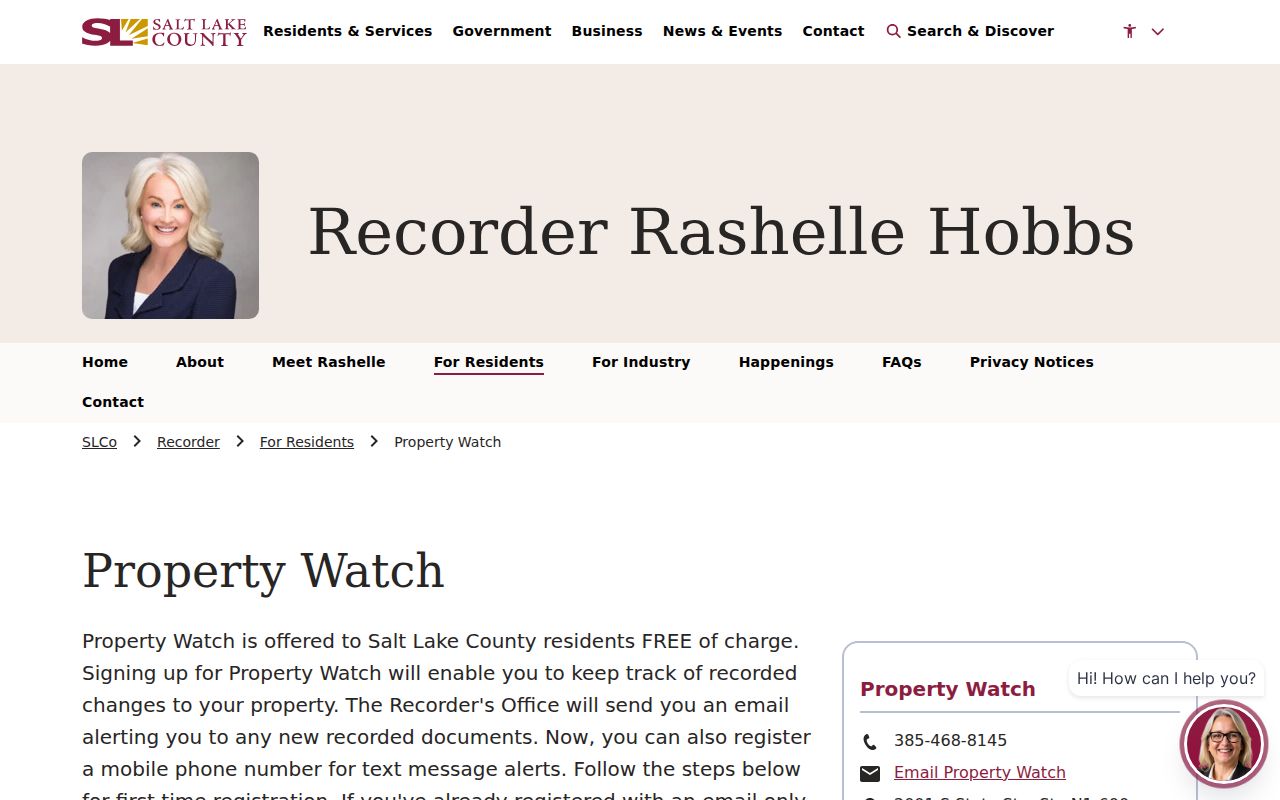
Salt Lake County offers Property Watch. The free service emails or texts an alert whenever a new document is recorded against a chosen property. Each notice lists the parcel number, entry number, document type, and recording date. Not every recording attaches to a property, though. Treat the alert as a tip, not a full title search.
Enrollment works from the physical property address, which may differ from the owner's mailing address. The county's Property Watch page explains the address selection and contact route. Other Utah counties may offer different services.
The Property Watch registration page shows the county's address-selection step:
Open each alert’s instrument and verify its parcel, parties, and type with the recorder.
Utah Probate Records Around Deeds
Deeds often carry a trustee or executor signature. The same page may list an administrator. A probate case can confirm that role. It can also authorize a court-approved sale. Utah Courts Xchange opens public case information within its coverage. Some images carry extra fees, and protected material stays closed. Search by party name or case number when a deed points to an estate event.
A petition or order adds context. It never replaces the county deed. Compare the representative's role and the legal description across both records. The statewide Utah Courts Xchange portal is the place to pull the court file.
What Utah Deed Records Cannot Prove
A recorded deed proves a transfer happened; it cannot prove no competing claim exists. An online index may lack an image or an older filing. A document may even sit under a prior parcel key. Signing, notarization, recording, and assessor updates each get their own date. Read each field for what it actually records.
County recorders keep instruments but never decide clear title. To trace earlier owners, follow the Utah former-owner chain. For a broad address-to-parcel lookup, start with Utah property search.